




While a service dog’s primary job is to perform tasks that mitigate their handler’s disability, their ability to work seamlessly and unobtrusively in the human world is just as critical. This is where Public Access Training comes into play.
Public access training ensures that a service dog can safely, confidently, and politely accompany their handler into spaces where pets are typically restricted—such as restaurants, grocery stores, flights, and medical facilities. To evaluate these vital skills, handlers turn to the Service Dog Public Access Test (PAT).
Here is an in-depth look at why public access training matters, what it involves, and how it protects the freedom and integrity of service dog teams.
Why Public Access Training Matters
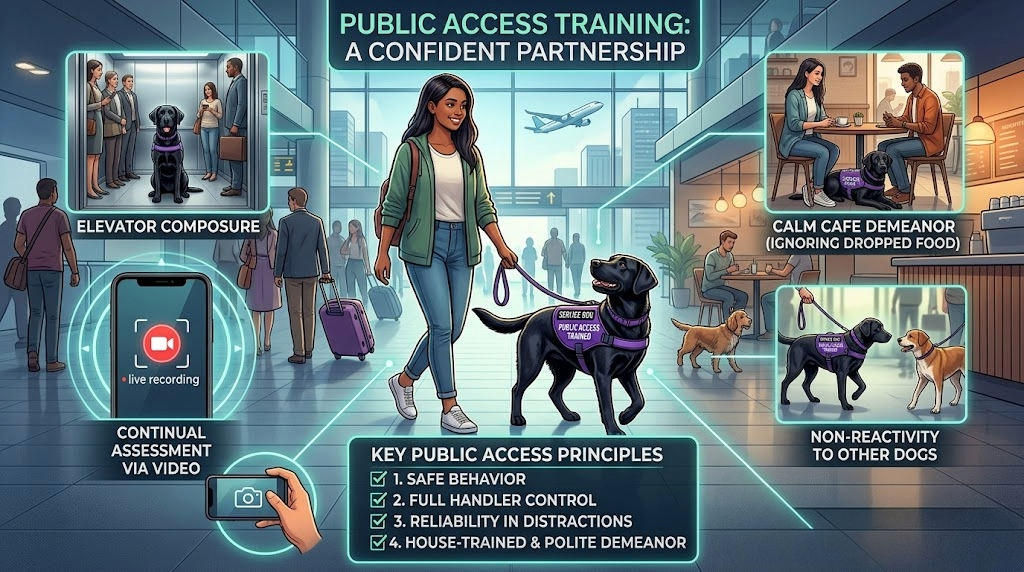
The core purpose of public access training is summarized by two principles: the dog must be safe to be in public, and the handler must demonstrate full control over the dog at all times.
Without proper public access training, a service dog team faces significant challenges:
-
Public Safety and Comfort: A service dog must never act aggressively, bark repeatedly, growl, or disrupt the environment. Proper training ensures the safety of the handler, the general public, and other working teams.
-
Confidence for the Handler: Knowing your dog can handle intense distractions, tight spaces, and sudden noises allows handlers to navigate the world without added anxiety.
-
Protecting Access Rights: Misbehaving dogs can legally be asked to leave public premises, regardless of their certification status. Exceptional public manners preserve a team's access rights and foster welcoming attitudes from business owners and store managers.
-
The 12-Month Standard: In line with top international assistance dog organizations across the US, UK, Canada, and Europe, a PAT certification is typically valid for 12 months. Annual reassessments preserve the long-term integrity, safety, and professionalism of the working team.
(Note: A Public Access Test (PAT) evaluation validates a dog’s public behavior and obedience, but it is distinct from a basic Service Dog Certificate, which confirms the dog has been trained to perform disability-specific tasks.)
What Does a Public Access Test Evaluate?
A comprehensive Public Access Test ensures a service dog can maintain flawless focus and behavior across multiple high-distraction scenarios. The evaluation generally tests a dog’s capability to:
-
Maintain Hyper-Focus: Remain calm and locked on the handler, ignoring food drops, heavy foot traffic, and strange sights.
-
Flawless Leash Manners: Walk on a loose leash at all times without pulling, straining, or lunging against the handler.
-
Reliable Command Execution: Sit, lie down, come on command, and hold stay positions perfectly until released.
-
Polite Public Demeanor: Navigate environments without sniffing merchandise, begging for food, or interacting with strangers without permission.
The 9 Core Evaluation Modules of the SDTSI PAT
The Service Dog Training School International (SDTSI) structures its Public Access Test into 9 specific real-world modules designed to simulate daily life in the city:
1. Mastery of Basic Skills
Evaluates the foundational obedience threshold. This includes how the dog responds to basic commands, respects boundaries, handles minor immediate distractions, and interacts politely with surrounding people.
2. Interactions with Strangers
Service dogs must tolerate strangers. This module tests how well the dog handles being approached or passed by adults, children, and other animals without interfering with their activities.
3. Parking Lot and Transportation Manners
Vehicles are a massive part of a service dog’s life. Handlers submit video evidence demonstrating that the dog remains calm, safe, and controlled while navigating parking lots, personal cars, and public transit like buses or trains.
4. Exploring a Building
Teaches the dog to enter and explore public buildings (schools, bakeries, post offices, hospitals) calmly, keeping their focus entirely on the handler rather than the environment.
5. Visiting a Restaurant
Restaurants pose a unique challenge due to abundant food drops and enticing smells. The dog is tested on self-control—specifically their ability to settle quietly under a table without begging or disrupting diners.
6. Elevator Manners
Elevators can be intimidating and cramped. This training ensures the canine enters, stands, and exits an elevator with complete confidence and composure, without crowding other passengers.
7. Store Manners
From local grocery stores to busy retail malls, daily errands require top-tier impulse control. The dog must show they can ignore items on low shelves and maintain perfect public manners.
8. Toileting Habits
A vital milestone for public access success. Service dogs must be reliably house-trained and capable of eliminating strictly on cue ("go potty") in designated outdoor areas before entering buildings.
9. Interaction with Other Dogs
When encountering other animals on or off-leash, a service dog must let the situation pass naturally without reactive barking or pulling. Eliminating dog-to-dog reactivity ensures the dog is never labeled a public danger.
How the Assessment Works
At SDTSI, the Public Access Test is a 100% online, self-paced program usually completed within 1 to 2 weeks.
Instead of stressful, formal in-person examinations, handlers utilize a method of continual assessment. Students submit specific photos and short video clips of their dog completing the exercises outlined in the 9 modules. A personal, professional tutor reviews the footage to provide constructive feedback, monitor progress, and approve the final 12-month certification.
Conclusion
Public access training is what transforms a highly skilled pet into a trusted, professional working partner. Passing a Public Access Test gives handlers the ultimate peace of mind, proving to airlines, landlords, and businesses alike that their service dog is an exemplary model of public safety and impeccable training.